TruPhoto — Three-Class Image Authenticity Classification
Tabeen Raoof and Joao Cozza · CS483, San Francisco Bay University, 2026 · supervised by Prof. Emdad Khan
Three-class image authenticity classifier (Real / Forged / AI-Generated) combining a frozen MobileNetV2 backbone with frequency-domain features, classified by an RBF-kernel SVM.
Apr 2026
Overview
Most published detectors treat image authenticity as binary — real versus fake. TruPhoto outputs three classes: Real, Forged (splicing and copy-move), and AI-Generated. A Photoshop manipulation and a diffusion output have different forensic signatures, and collapsing them discards information a forensic user needs. The three-class framing is a harder problem: chance is 33%, not 50%.
Approach
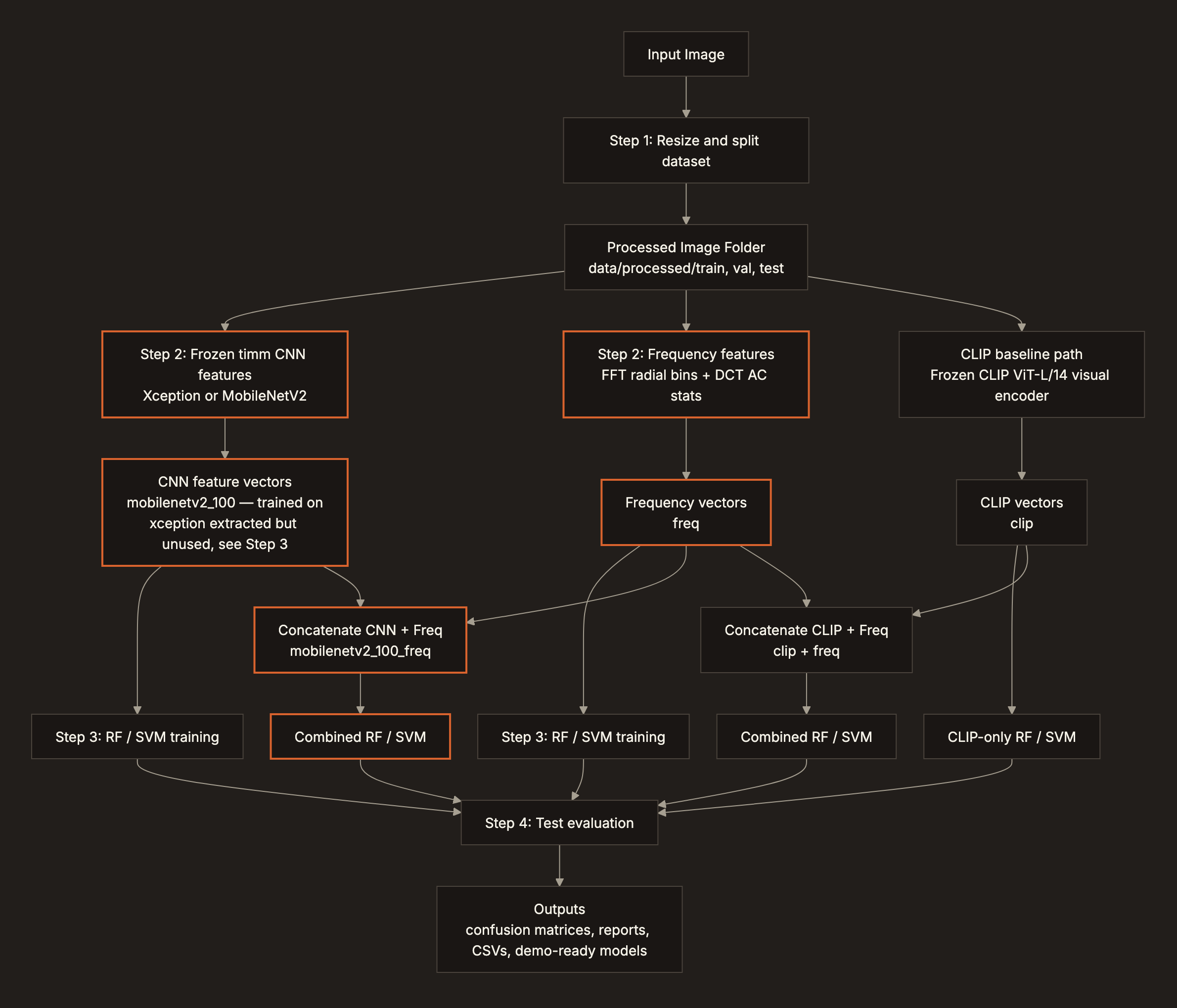
Two parallel feature paths feed a single classifier.
Semantic path. A frozen MobileNetV2 backbone produces 1,280-dimensional semantic features — what is in the image.
Frequency-domain path. A parallel path produces 228-dimensional content-invariant features — how the image was made:
- FFT radial power-spectrum fitting, following Dzanic et al. (NeurIPS 2020) — 102-d
- Block-DCT coefficient statistics, following Frank et al. (ICML 2020) — 126-d
The two paths are concatenated to 1,508 dimensions and classified by an RBF-kernel SVM. Nothing is fine-tuned; both backbones are frozen feature extractors. This is the project's actual contribution — the frequency path is what separates TruPhoto from a CNN-features-plus-classifier baseline.
Results. 75.70% test accuracy on 4,519 held-out images, a +2.43pp improvement over the CNN-only baseline of 73.27%. The frequency features alone reach 71.14% accuracy using only 228 dimensions and no semantic content at all. Training data: 30,123 images from 36 sources across ArtiFact and CASIA 2.0, spanning 25 AI generators. The full pipeline is CPU-only and runs in about 5.5 hours on a laptop with no GPU.
What the iterations showed
Accuracy decreased across the first four iterations as each shortcut was removed — roughly 84% → 76% → 77.6% → 74.9%. A cross-source sanity check surfaced three dataset-handling bugs along the way:
- A label-inference bug silently dropping 24 of 25 AI generator sources.
- Sampling that gave one generator about 70% of the AI training set.
- A dataset-identity shortcut — the model had learned to tell ArtiFact apart from CASIA rather than real from forged.
Iteration 5 recovered 2.43pp through the frequency path — a genuinely new representation, rather than a new shortcut.
Why we didn't fine-tune
Three independent lines of evidence pointed away from fine-tuning the backbone:
- Per-source spread. Accuracy varied by 62.7pp for AI-Generated and 59.4pp for Real across sources, both far above the ~15pp threshold at which fine-tuning is considered safe.
- More data didn't help. Accuracy fell when training data was increased 2.5×, indicating a representational ceiling rather than a data shortage.
- A specific failure mode. StyleGAN3 at 37% accuracy is a representation problem, not a capacity problem — its alias-free upsampling removes exactly the spectral artifacts the DCT path is built to detect.
Limitations
- StyleGAN3 (37%) and Stable Diffusion (62%) are both below deployment-useful thresholds.
- JPEG storage at q=95 attenuates frequency features.
- Generative inpainting regressed accuracy by about 10pp, because image-level frequency statistics get diluted by surrounding authentic pixels.
- Output probabilities are uncalibrated.
- Single-seed evaluation — no cross-validation.
Stack
Python, PyTorch, timm, MobileNetV2, scikit-learn, scipy, numpy, Pillow, Gradio
Links
- GitHub: github.com/TabeenRaoof/xception-photo-verification
- Preprint: in preparation — arXiv link coming soon
Architecture
Status
Preprint in preparation — arXiv link coming soon.